Squarespace vs. Shopify: Selling Fees, Content and Store Ownership
Start a Squarespace evaluation with the content experience and the kind of product or access you sell. Start a Shopify evaluation with checkout, inventory and fulfilment. HRL recommends that framing because a portfolio with occasional sales, a member-content business and a stock-led store have different acceptance tests.
Neither a template preference nor a low starting subscription resolves the decision. Document the customer journey and the work the business must perform after payment. Then select the smallest plan and tool combination that can demonstrate that entire journey.
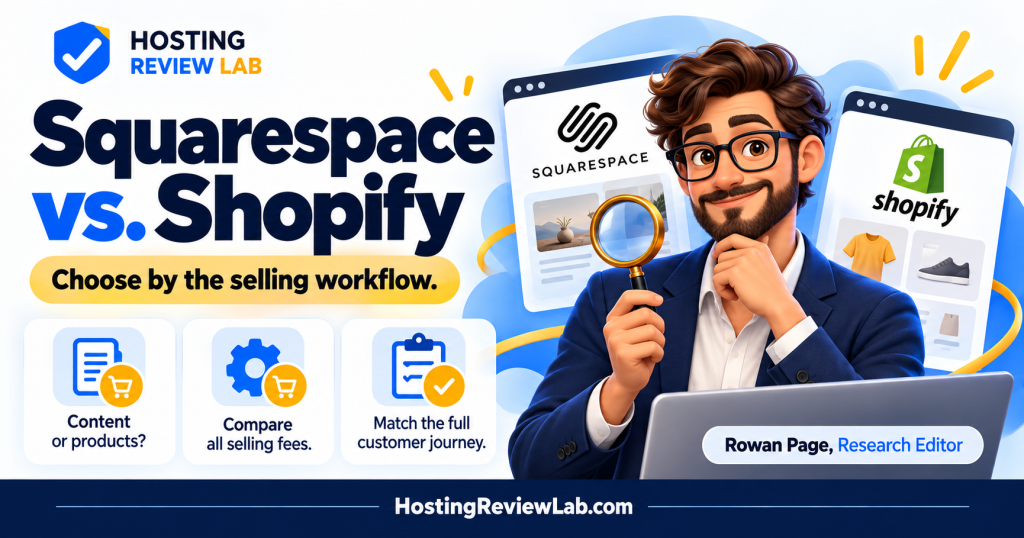
Choose by the selling workflow
| Business need | Squarespace check | Shopify check |
|---|---|---|
| Content and service pages | Demonstrate the required layouts, enquiry handling and any separate booking service. | Demonstrate the selected theme’s content layouts and any service-specific tools. |
| Physical or download products | Match product type to the commerce fee schedule and test delivery. | Test product data, stock where relevant, and the required delivery workflow. |
| Courses or member access | Check the fee schedule for courses, video pages and member sites separately. | Confirm the chosen access or course solution, its recurring cost and customer account flow. |
| Ongoing operations | Verify order handling, refunds and required integrations. | Verify checkout, fulfilment, returns and the plan or apps each integration requires. |
These are evaluation tasks, not HRL test results. If an essential feature is supplied by another service, check that service’s billing, access and export terms too. Record the dependencies before selecting an annual subscription.
Subscription prices belong beside selling fees
Our Squarespace pricing guide separates the Basic, Core, Plus and Advanced plan family, observed billing selections and selling fees. Our Shopify pricing guide separates US subscription rates, annual upfront bills, processing and third-party transaction charges. Use the exact plan shown in your account; legacy plan names and terms can differ.
Keep country, currency, billing term and tax treatment consistent when comparing quotes. An annual monthly equivalent is not the amount of a monthly-billing invoice. List domain renewal, mailbox subscriptions, paid extensions or apps and implementation work outside the website subscription.
What you sell changes the fee comparison
Squarespace’s official fee schedule distinguishes payment processing from platform transaction charges. Platform charges depend on the billing plan and product type. Courses, video pages and member sites have a different schedule from commerce products; a download product should not automatically be classified as a course or membership.
Shopify’s official pricing comparison separately lists processing and third-party transaction rates. Confirm the gateway and applicable conditions for your actual payment mix. A third-party app that delivers a course or manages recurring access can add another bill and its own operational requirements.
Calculate each candidate’s subscription, applicable platform charge, processor charge and required tools using the same eligible sales assumptions. Include international or premium-card differences where relevant. A plan with no applicable platform transaction fee can still incur payment-processing charges.
For an upgrade decision, divide the extra recurring subscription cost by the relevant percentage-fee reduction, then account for any changed processing or app costs. This is an HRL calculation method, not an automatic recommendation to buy the higher tier. If the two options do not support the same customer journey, their fee totals cannot settle the choice.
Squarespace exports are useful but partial
Squarespace’s site-export documentation describes an XML export of certain content for WordPress. Store pages, style settings and custom CSS are among the exclusions. It is not a downloadable replacement for the complete website.
Products have a separate CSV export. The documented omissions include additional product information, customer reviews, featured images, image alt text and variant images. A destination can also require a different CSV format. Preserve those omissions and test representative imports before treating the file as a migration plan.
A Shopify theme download has limits too
Shopify’s backup and duplication guide supports CSV record exports and a theme download, while requiring app reinstallation and settings work for duplication. Do not assume that a theme or product CSV supplies a complete working store on another platform.
For both options, document customers, orders, memberships or subscriptions, media, redirects and the replacement for each dependency. Define how existing customers will access purchases on the destination. Keep domain registration and email live while the website changes. Our builder portability guide and email-preserving move guide cover the separate decisions.
Price each sales workflow separately
A business selling both physical goods and paid content should model those workflows on separate rows. Record the relevant subscription, platform fee, payment charge and required add-on for each. Then test the customer’s access after purchase and after a refund. A single headline commerce rate can hide different product rules, while a successful product checkout does not establish the membership workflow.
Which option belongs on your shortlist?
HRL would first evaluate Squarespace for a project where content presentation and a clearly defined selling or access workflow are the core requirements. We would first evaluate Shopify where repeatable store operations and the required commerce integrations drive the brief. In both cases, approval depends on a working demonstration and a dated, complete budget.
If choosing the host and managing the application stack independently are requirements, also read Shopify versus WooCommerce and cost the operating support. For another hosted-builder comparison, use Wix versus Shopify. Document ownership and acceptance with the business website handover checklist.
Provider documentation checked October 5, 2026. Recommendations and acceptance checks are HRL analysis; we have not performed hands-on checkout, migration, support or performance tests for this comparison. See our review methodology and affiliate disclosure. Provider links are direct links.