Monthly vs. Annual Web Hosting: Upfront Cost, Renewals and Flexibility

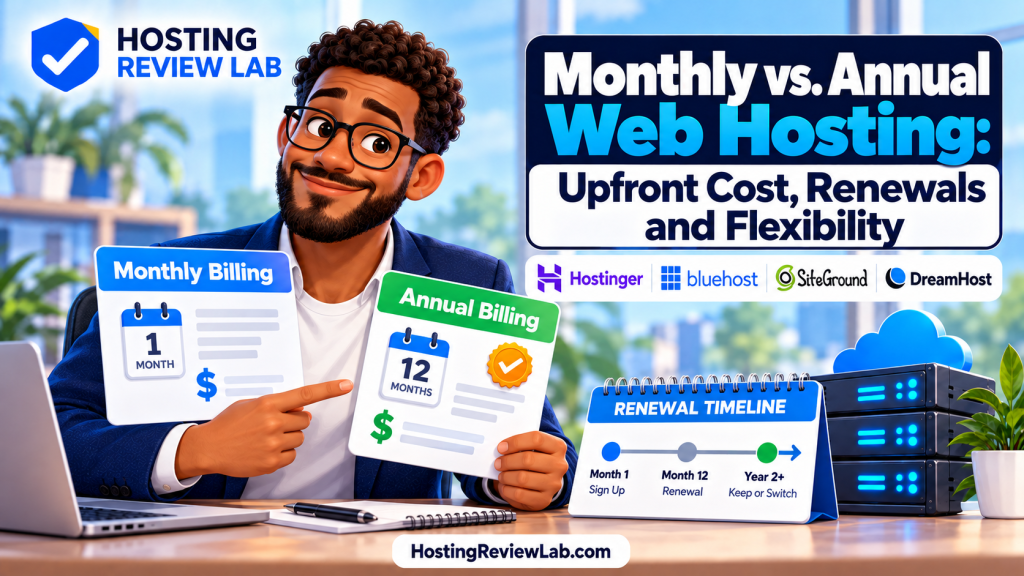
Monthly hosting is usually the better fit when flexibility and a smaller initial payment matter most. Annual hosting can be better value when you expect to keep the site and the same host for at least a year. Compare the actual invoices, renewal terms and included services before choosing. A price displayed “per month” does not establish monthly billing.
The question is not just whether a year costs less than twelve monthly payments. It is whether buying that year makes sense for a project that might change in three months.
Monthly versus annual hosting at a glance
| Question | Monthly billing | Annual billing |
|---|---|---|
| What do you pay at signup? | Typically one billing period, plus any initial fees. | Typically the whole year, plus any initial fees. |
| What does the rate represent? | A charge for each monthly cycle, unless the offer states otherwise. | Often a monthly equivalent used to describe a prepaid annual charge. |
| What if the project ends early? | You may avoid later monthly charges after canceling under the terms. | Unused months may not be refundable once the applicable refund window closes. |
| When does a promotion end? | Check whether the first month differs from later months. | Check the rate and payment cycle for the second year. |
| When can you switch hosts? | Billing can offer flexibility, but migration still takes work. | You can move the site, but may still have paid for unused service. |
These are general billing patterns, not guarantees about every provider. Usage-billed cloud hosting, trials and multi-year offers need their own invoice checks.
How to spot a monthly equivalent
Look for the billing selector and total due, not only the large price on the plan card. An offer advertised at $5 per month with a 12-month term means $60 in prepaid hosting if there are no other charges. It does not mean twelve optional $5 payments. A 36-month selection at the same equivalent means $180 up front.
Before paying, save the selected plan name, prepaid period, hosting subtotal, optional services and the next renewal date. If the provider offers several term choices, record the rate and renewal cycle for the one you actually choose. A renewal rate attached to a different term is not an interchangeable quote.
Calculate when annual prepayment becomes cheaper
Use a simple first-term comparison:
Break-even months = annual hosting payment ÷ comparable monthly hosting rate.
This formula compares cash for hosting only, assumes the same useful features, and applies while the monthly rate stays unchanged. Add setup fees and required extras if they differ.
Example: $8 monthly versus $60 for a year
These are illustrative amounts, not a provider offer. Paying $8 each month costs $48 over six months, $64 over eight months and $96 over twelve months. The annual payment is $60 whether you use six months or twelve, assuming no refund.
- Six-month project: monthly payments total $48, saving $12 compared with the annual payment.
- Eight-month project: monthly payments total $64; the annual payment is $4 lower.
- Full year: annual prepayment saves $36, provided the plan continues to fit.
The break-even point is 60 ÷ 8 = 7.5 months. With complete monthly billing periods, the annual payment becomes cheaper at the eighth payment. That arithmetic does not account for changing your mind, lost time moving the site or an unused annual balance.
When a current plan renews, compare the full cost of staying, renegotiating or moving, including migration work and overlapping subscriptions.
Compare the second year before celebrating the discount
Suppose that illustrative $60 annual plan renews for $120, while the comparable monthly plan stays at $8. Annual payments would total $180 over two years; monthly payments would total $192. Annual billing still costs less across those two years, but the saving is now $12 rather than repeating the first year’s $36 saving.
That is why the introductory rate and renewal rate belong in the same comparison. For actual provider records, use our pricing and renewal library and cost calculator. Count full invoices when they become due, not a prorated share of an annual or multi-year payment.
When monthly hosting makes sense
- A new project with uncertain demand: preserve cash while you learn whether the site is worth continuing.
- A short-term campaign or test site: compare the planned lifetime with the annual break-even point.
- A host you have not used before: evaluate the service without a long prepaid balance, after checking setup and cancellation rules.
- A workload that may change: check how upgrades, downgrades and usage charges affect each invoice.
For named providers and their billing models, see our monthly hosting shortlist. DreamHost’s Web Hosting documentation lists a monthly choice, but product and order selections can differ. A multi-year promotional rate should not be assumed to apply to that choice.
When annual hosting makes sense
Annual prepayment deserves consideration when the website has an ongoing purpose, the host already meets your needs and the total bill saves enough to justify the commitment. The plan’s storage, site allowance, backups and support should fit the coming year. Paying annually for an unsuitable plan is not a useful discount.
For an established business, ask whether the larger initial payment leaves enough budget for the domain, email, backups and other services. Put each service’s invoice date on the same calendar; email or domain charges may occur before hosting renewal.
Refunds and cancellation are separate from the billing rate
A money-back guarantee has conditions and a deadline. It does not automatically promise a prorated refund for any unused months. Domain registration, email, setup work and renewals may follow different rules from a new hosting purchase. Monthly terms can also have different refund eligibility.
Read our hosting refund guide, then confirm the policy for the exact order. Keep backups and export access ready before canceling. If mail is bundled with hosting, plan what happens to those mailboxes too.
Five details to check in the cart
- The exact amount charged immediately, including tax and selected extras.
- The number of months that payment purchases.
- The date, rate and period of the next hosting invoice.
- Any trial that becomes a paid email, security or backup service.
- The cancellation deadline, refund conditions and process for keeping your data.
Sources and scope
Billing documentation checked October 1, 2026: DreamHost Web Hosting overview and Bluehost’s invoice and renewal guidance. All dollar examples in this guide are hypothetical calculations. Verify a provider’s selected cart and renewal settings before buying.
For a longer horizon, continue with our renewal-cost guide or compare hosting renewal commitments.