WordPress Staging Isolation: Email, Payments and Search Checks

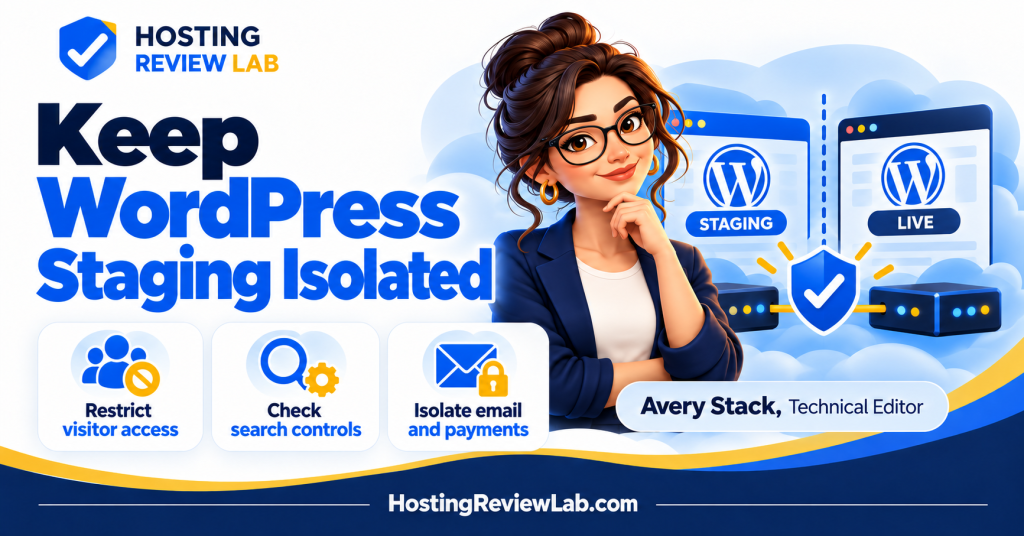
A separate staging URL does not establish that the copy is disconnected from customers. Before running a test, check what the copied application can send, charge, update or publish through its integrations. The goal is a useful test environment with a documented boundary.
This page covers isolation before testing. For choosing a staging service and planning deployment, use the WordPress staging guide. For the release itself, follow the update checklist.
Name the environment and review its connections
Record the staging hostname, copy date, owners and intended tests. Label the environment clearly in the team’s records. Identify the people allowed to access it and the person responsible for removing the copy when it is no longer needed.
Review settings with the maintainer before pressing a checkout, booking or form button. Ask whether credentials were copied, which external accounts they point to and what automated work can run without somebody visiting the site. Write down the exceptions required for your test; “everything is probably in test mode” is not a useful record.
| Connection | Question before testing | Evidence to retain |
|---|---|---|
| Public access | Is the copy protected by the host’s supported access control? | Authorized access succeeds; an unauthorized check meets the intended restriction. |
| Where do messages go, including mail sent by an external service? | Approved test inbox receives a labeled test; no unintended recipient is used. | |
| Payments | Does the gateway use its supported sandbox and test credentials? | Environment identified in the gateway and test transaction record. |
| Fulfilment and CRM | Can this copy create a shipment, ticket or customer record? | Integration owner confirms the test destination or approved isolation. |
| Scheduled work | Which reminders, renewals, exports or sync jobs can run? | Job owner, intended behavior and observation window. |
| Analytics and advertising | Are test events separated from production reporting and campaigns? | Measurement owner confirms the chosen test arrangement. |
Control access and search discovery separately
Use the hosting platform’s supported access restrictions for a private copy. Do not rely on an obscure URL as the access policy. Ask the host how authorized testers, automated checks and necessary external callbacks should reach the environment.
Google’s noindex documentation explains that a crawler must be able to access a page to see a noindex directive, and that robots.txt blocking can prevent this. Search exclusion and private access are different controls. Have the administrator apply the appropriate arrangement for the copy; this is not an instruction to expose a private environment merely so Google can crawl it.
When deploying later, review the live site’s intended search settings separately. Do not assume that a staging setting belongs in production or that every deployment method copies the same settings.
Verify email at the delivery boundary
For a concrete provider example, Kinsta’s staging documentation says transactional mail is enabled by default. That demonstrates why email behavior should be checked rather than inferred from an environment label. Other hosts and configurations can differ.
Ask the mail owner whether an application-level suppression method covers every route the site uses. Include external email APIs, SMTP services and marketing integrations in the review. Use the email delivery checklist for evidence, directing tests only to approved recipients.
Review payments, webhooks and scheduled actions
Inspect the payment extension’s environment and follow its own sandbox instructions. Ask the integration owner to review outbound delivery URLs and any inbound callbacks the test requires. Use the WooCommerce webhook checklist for outgoing event notifications; payment-provider callbacks are a separate integration.
Check WordPress cron and WooCommerce scheduled actions with the maintainer. Decide which work must run for the rehearsal and which must remain isolated. Avoid a blanket change that prevents the very workflow the test is meant to prove.
Run one controlled test before the full rehearsal
Choose a harmless, labeled action appropriate to the environment. Have the responsible owners confirm the resulting email, transaction or external record. If an unexpected destination receives activity, stop the rehearsal, preserve the reference and correct the boundary before continuing.
For a store, proceed with the test-order checklist only after the connected systems are ready. Keep the isolation record with the release notes so the next maintainer knows what was deliberately changed for testing.
Check an external destination before rehearsal
A hypothetical staging copy may retain a production fulfilment URL or sending-service credential. Verify the configured destination and perform a harmless labeled check with the receiver owner before running the wider rehearsal. Password-protecting the staging page controls visitors; it does not by itself redirect outbound integrations. Record the isolation method for each connection that the test will exercise.
Sources and scope
Official Google and Kinsta documentation checked October 5, 2026. The isolation table and acceptance process are HRL’s recommendations. This page does not report a staging configuration tested by HRL or guarantee that a particular suppression plugin covers every integration.